
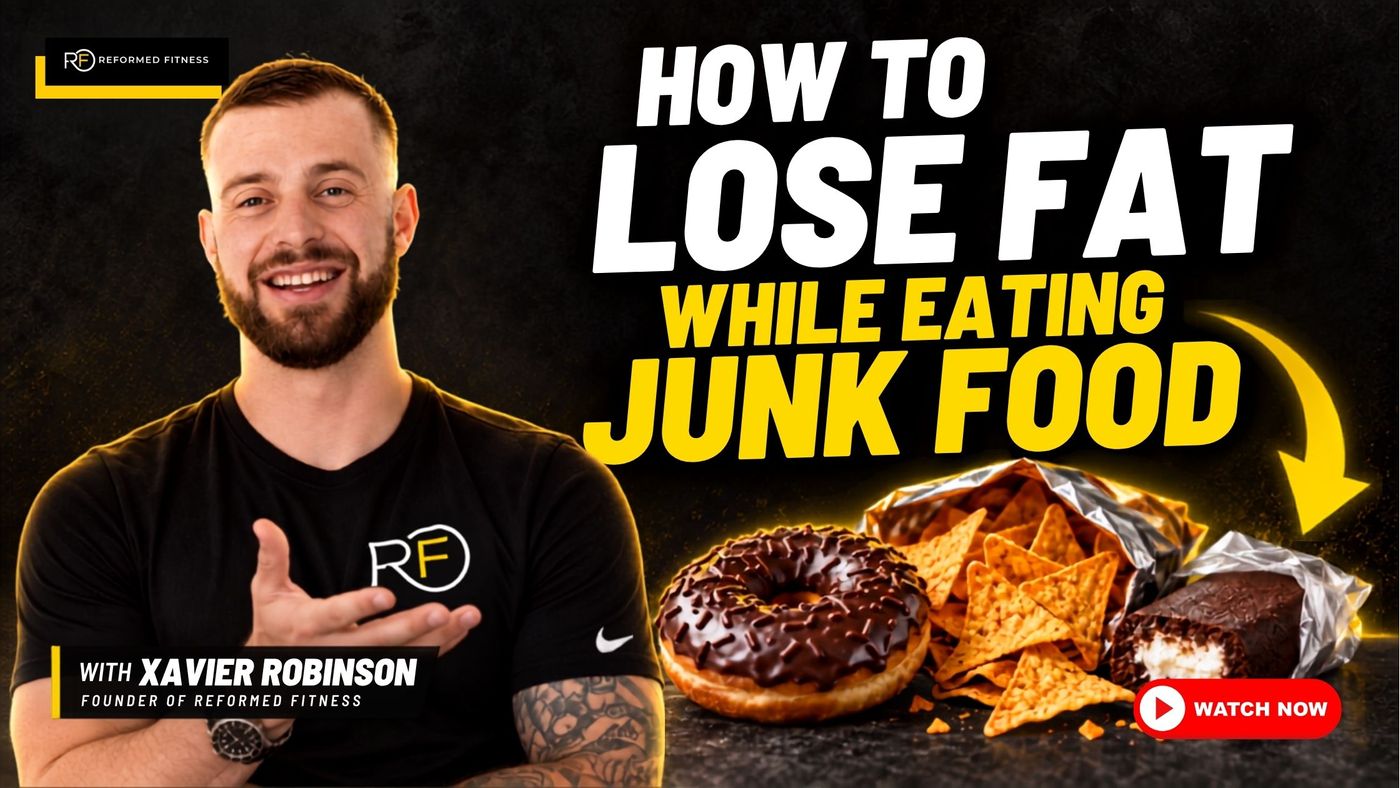
Can You Lose Weight While Eating Junk Food?
Xavier Robinson
Most people who decide they want to lose ten or fifteen pounds begin by thinking about everything they need to stop eating. Dessert has to go. Pizza or burgers become a cheat meal. Alcohol disappears for a month. Carbohydrates suddenly become the enemy, snacks get thrown out of the pantry, and Monday morning begins with a refrigerator full of foods that look considerably different from what they were eating the week before.
The problem isn't necessarily that those changes are unhealthy. The problem is that you're also expected to maintain them while traveling for work, going to restaurants with friends, sitting through business dinners, celebrating birthdays, managing your children's schedules, and occasionally wanting to eat something simply because you enjoy it. Eventually, one of those foods makes its way back into your diet, and many people immediately feel like they've failed.
This is where understanding the physiology of fat loss can actually make nutrition feel considerably less restrictive. You can eat pizza and lose body fat. You can eat ice cream and lose body fat. You can have a cheeseburger, drink a glass of wine, or eat a doughnut and still make progress. You could theoretically construct a remarkably poor diet and still lose weight if you consistently consumed less energy than your body expended.
That doesn't mean I recommend doing it. It means fat loss and healthy eating are not exactly the same physiological question, and understanding the difference can help you build a nutrition strategy that supports your health without requiring perfection.
Yes, You Really Can Lose Fat Eating “Junk Food”
One of the more famous examples of this principle came from Mark Haub, a professor of human nutrition at Kansas State University, who conducted a personal experiment that eventually became known as the “Twinkie Diet.” For ten weeks, much of his diet consisted of snack cakes, chips, sugary cereals, and other foods that would hardly appear in a conventional weight-loss plan. He limited his total energy intake to approximately 1,800 calories per day and reportedly lost 27 pounds.
It is important to understand what this was and what it wasn't. This was one professor experimenting on himself, not a randomized controlled trial or peer-reviewed study, so I wouldn't use it as scientific proof of anything. What makes the story interesting is that the outcome illustrates a fundamental principle that has been demonstrated repeatedly in controlled research: when you consistently consume less energy than you expend, your weight will decrease.
A large randomized trial published in The New England Journal of Medicine demonstrated this nicely. Researchers assigned 811 adults to four reduced-calorie diets containing different proportions of carbohydrates, fat, and protein and followed them for two years. Despite meaningful differences in macronutrient composition, weight loss was similar among the groups. The authors concluded that reduced-calorie diets can produce meaningful weight loss regardless of which macronutrient they emphasize.
This is the part of nutrition that often gets buried underneath whatever diet happens to be popular at the moment. Your body requires energy every day to keep you alive, move you through the world, maintain your tissues, digest food, think, work, exercise, and perform thousands of other biological processes. We measure that energy in calories. When you consistently consume less energy than you're expending, your body has to make up that difference from stored energy, including body fat. When you consistently consume more than you're expending, some of that excess energy can eventually be stored.
Keto doesn't escape that equation. Neither does intermittent fasting, Paleo, low-fat eating, or whatever nutrition strategy becomes popular next year. Those approaches can absolutely help someone lose weight, but to the extent that they do, one major reason is that they help that person reduce overall energy intake.
That distinction matters because it changes the question from “What foods do I have to eliminate?” to “How much am I actually eating?”
“But I Eat Healthy” Doesn't Necessarily Mean You're in a Calorie Deficit
This is one of the most common conversations I have with people who are frustrated with their weight. They tell me they eat pretty healthy, and quite often they're right.
Breakfast might be oatmeal with peanut butter and fruit. Lunch could be a salad with chicken, avocado, dressing, and nuts. Dinner might include salmon, brown rice, vegetables, and olive oil. Snacks could be almonds, hummus, Greek yogurt, or a smoothie. There is nothing inherently wrong with those foods, and many of them provide excellent nutrition.
The problem is that your metabolism doesn't give calories from almonds a free pass because almonds contain micronutrients and healthy fats. Peanut butter is nutritious and calorically dense. Nuts are nutritious and calorically dense. Olive oil is nutritious and calorically dense. Avocado is nutritious and relatively energy dense. Smoothies can contain several hundred calories without feeling like a substantial meal.
Add slightly oversized portions, a few bites while cooking dinner, a coffee drink in the morning, a restaurant meal over the weekend, and a couple glasses of wine, and it is entirely possible to eat a nutrient-dense diet while consuming enough energy to maintain or increase your weight.
This is why I don't like the phrase “clean eating." It answers a different question. Food quality tells us something important about the nutritional characteristics of your diet. Energy balance tells us whether your fat mass is likely to increase or decrease over time. You should care about both, but you shouldn't confuse them.
If you've spent months telling yourself, “I don't understand why I'm not losing weight because I eat really healthy,” you may not need another diet. You may simply need a more accurate understanding of how much you're already eating.
If Calories Matter So Much, Why Does Food Quality Matter?
This is where the conversation becomes more nuanced than “calories in, calories out.”
Imagine you have approximately 500 calories available for breakfast. One option is a substantial omelet made with eggs, vegetables, and a lean protein source alongside some fruit. Another option is a large pastry or a couple of smaller doughnuts. From the standpoint of your daily energy intake, 500 calories is still 500 calories. From the standpoint of what happens during the next several hours, however, those breakfasts can be very different.
The omelet can provide a substantial amount of protein, vitamins, minerals, and food volume. Add fruit or another fiber-rich food and you have a meal that takes some time to eat and may keep you satisfied for several hours. A couple of doughnuts can deliver a similar amount of energy in a much smaller amount of food while providing considerably less protein and fiber. You haven't ruined your fat loss by eating the doughnuts, but you may have made the rest of the day harder.
A fascinating randomized controlled trial from Kevin Hall and colleagues at the National Institutes of Health demonstrated why this distinction matters. Participants lived in a metabolic ward and were provided either an ultra-processed or unprocessed diet for two weeks before switching to the other condition. The diets presented to them were designed to be matched for several nutritional variables, and participants were allowed to eat as much or as little as they wanted. When people were given the ultra-processed diet, they spontaneously consumed about 500 additional calories per day and gained weight. During the unprocessed diet, they consumed less and lost weight.
The lesson isn't that eating a processed food magically causes body fat regardless of calories. That's not what the study showed. The more useful lesson is that the foods you choose can influence how easy it is to consume those calories.
You probably don't need a metabolic ward to recognize this in your own life. Eating 1,000 calories of pizza isn't particularly difficult. Eating 1,000 calories of chicken breast, potatoes, broccoli, and fruit requires considerably more commitment. A bag of chips can disappear during a television show without ever feeling like dinner, while consuming the same number of calories from lean protein, vegetables, potatoes, and fruit might require multiple plates of food.
This is where protein, fiber, fruits, vegetables, minimally processed carbohydrates, and other nutrient-dense foods earn their place in a fat-loss diet. They aren't magical fat-burning foods. They simply make it easier to build meals that provide nutrition and satisfaction while keeping total energy intake under control.
Protein becomes particularly important when you're trying to lose fat because the goal shouldn't simply be to make the number on the scale smaller. Ideally, you want to lose unnecessary body fat while preserving as much muscle as possible. That's one reason we pair adequate protein intake with strength training when we're coaching someone through fat loss rather than focusing exclusively on calories and cardio.
So yes, calories ultimately matter tremendously for weight loss. Food quality helps determine how miserable or manageable the process of controlling those calories becomes.
Stop Treating Your Diet Like a Purity Test
For most busy professionals this is where I think nutrition advice becomes unnecessarily unrealistic.
You have business dinners. You travel. Your kids want pizza on Friday night. Someone brings dessert to a birthday party. You go on vacation. You have friends over on Saturday. Maybe you genuinely enjoy a glass of wine with dinner.
Those aren't interruptions to your real life. They are your real life.
A nutrition strategy that works only when you have complete control over your environment isn't particularly useful. If losing weight requires you to never eat dessert again, never order pizza with your family, never have a drink at dinner, and never deviate from a predetermined meal plan, I can understand why maintaining weight loss feels nearly impossible.
Instead, I prefer to think about nutrition more like a budget than a purity test. If you know you're going to a nice restaurant tonight, you don't need to starve yourself all day, but you can make reasonable adjustments. Breakfast might emphasize protein, fruit, and a smaller than usual portion size. Lunch might be lean protein with a large serving of vegetables and nothing else. You probably don't need to mindlessly snack throughout the afternoon. Then you arrive at dinner with more flexibility available within your overall intake.
The same principle applies to dessert. Dessert doesn't have to become a “cheat meal.” Maybe you eat it and keep the rest of your day relatively normal. Maybe you split it with your spouse. Maybe you skip a snack earlier in the day that you don't care nearly as much about. Maybe you simply accept that today will be a little higher in calories and return to your normal routine tomorrow.
One meal rarely determines your progress. Your repeated patterns do.
You don't need to classify those foods as “bad” in order to understand that they probably shouldn't make up most of your diet.
A doughnut can fit. Pizza can fit. Ice cream can fit. The Friday-night restaurant can fit. What becomes difficult is trying to fit all of those things, in unlimited portions, into every day while also maintaining the calorie deficit required for fat loss.
That's not restriction. That's tradeoffs.
And every sustainable nutrition plan involves them.
Learn What You're Actually Eating Before You Change Everything
If I were trying to lose body fat without giving up the foods I enjoyed, I wouldn't begin by changing my entire diet. I would spend seven days learning what I was already eating.
Track a normal week without trying to impress yourself. Include the handful of snacks while you're cooking, the creamer in your coffee, the dressing on your salad, the drinks on Friday night, the handful of nuts at your desk, and the bites you take from your child's plate. The objective isn't to judge the week as good or bad. You're gathering information.
There is good evidence behind this strategy. A 2021 systematic review and meta-analysis examined digital self-monitoring of diet and physical activity in adults with overweight or obesity and found that these interventions can support weight-loss efforts. Self-monitoring isn't magic, but it makes an invisible behavior visible, which gives you something concrete to change.
Once you have seven days of information, don't immediately start eliminating everything you enjoy. Look for the calories that aren't providing much value.
Maybe you discover that the supposedly healthy smoothie you drink every morning has 700 calories and doesn't keep you full until lunch. Maybe the handful of almonds you grab several times throughout the workday adds up to far more than you realized. Maybe the two glasses of wine on Thursday become three on Friday and Saturday. Maybe your meals are perfectly reasonable, but you're consuming several hundred calories between them without really noticing.
Those are useful discoveries because they allow you to make targeted changes instead of unnecessarily rebuilding your entire diet.
If pizza with your family on Friday night is one of your favorite meals of the week, I'd rather help you keep the pizza and find 300 calories somewhere you barely care about. Sustainable nutrition isn't about maximizing sacrifice. It's about figuring out which changes produce the most meaningful result with the least disruption to your life.
Once you understand your intake, create a modest calorie deficit and give it enough time to work. Keep protein present throughout the day, continue eating plenty of fruits and vegetables, stay hydrated, and maintain your strength training. Then evaluate the trend over several weeks rather than reacting emotionally to what the scale does tomorrow morning.
The goal isn't to see how little food you can survive on. It's to find the highest amount of food you can reasonably eat while still progressing toward your goal.
Ready to Build a Plan That Actually Works?
We get it, you don't have a lot of time to spend on exercise, you have decision fatigue from all of the important choices you make at work and at home every day, and it's hard to sift through the noise and know what actually works. Schedule a 15 minute FREE Discovery Call with one of our Exercise Physiologists so we can create a FREE personalized action plan for you. If you don't think that plan will save you time, avoid decision fatigue, and cut through the noise we will give you ONE MONTH OF FREE 1 on 1 PERSONAL TRAINING SESSIONS.